
Adults lose roughly 3–8% of muscle mass per decade after 30, and the pace picks up around menopause as estrogen declines. The fix is direct: strength training two to three times a week plus enough protein. Muscle responds to training at any age — it is never too late to start.
Muscle loss doesn't announce itself. There's no hot flash, no obvious symptom. Just a jar that's harder to open, stairs that feel a little longer, and a metabolism that quietly slows down.
Doctors call it sarcopenia. Most women have never heard the word — yet it shapes weight, energy, bone health, and independence for decades. Here's what's happening and exactly how to turn it around.
What is sarcopenia, in plain English?
Sarcopenia is the gradual, age-related loss of muscle mass and strength. It starts earlier than most people think: research places the decline at roughly 3–8% of muscle mass per decade beginning around age 30, accelerating after 60.
For women, there's an extra chapter in the story. Estrogen supports muscle maintenance — so as it declines through perimenopause and menopause, muscle loss tends to speed up right when life gets busiest.
Why does muscle matter so much after 40?
Metabolism. Muscle burns calories around the clock, even while you sleep. Losing it is one of the main reasons weight creeps up in midlife — we break down that whole picture in Weight Gain After 40: Why Your Body Changed.
Bones. Strength training loads your bones, and bones respond by staying dense. After menopause, when osteoporosis risk climbs, that's not optional — it's protective.
Blood sugar. Muscle is where your body stores and burns glucose. More muscle means better blood sugar control.
Independence. The strength you build in your 40s and 50s is the strength you'll carry groceries with — and get up off the floor with — in your 70s and 80s. This is long-game self-care.
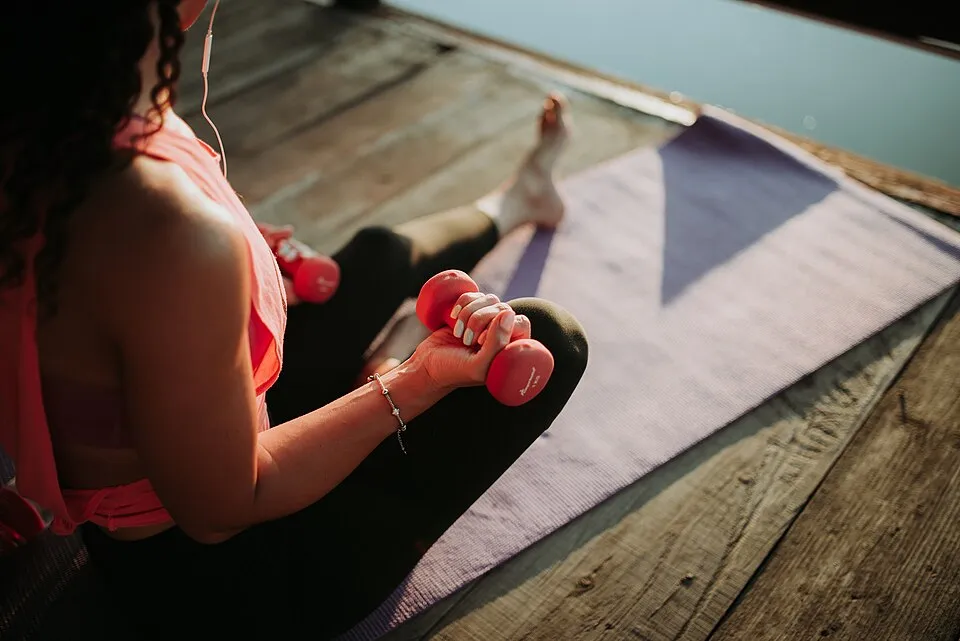
How do you start strength training safely at home?
Forget the intimidating gym imagery. Strength training after 40 starts with simple movements done well, twice a week. Here's a realistic first month.
Weeks 1–2: learn the movements
- Chair squats — stand up from a chair without using your hands. 2 sets of 8.
- Wall push-ups — hands on the wall, body straight. 2 sets of 8.
- Step-ups — onto a low, stable step. 2 sets of 6 per leg.
- Farmer's carry — walk around the house holding something moderately heavy. 2 trips.
Weeks 3–4: add gentle resistance
Add light dumbbells (start with 3–5 lb) or a resistance band. Move to 3 sets. When a weight feels easy for 12 repetitions, it's time for the next one up. That gradual increase — progressive overload — is the entire secret of strength training.
Two rules that keep you safe: stop any exercise that causes sharp pain, and leave at least one rest day between sessions for the same muscles. Sore is normal; pain is information.
How much protein do you need to rebuild muscle?
Training gives the signal; protein supplies the bricks. Without enough of it, your body can't rebuild what you're asking it to.
Expert groups studying aging recommend roughly 1.0–1.2 grams of protein per kilogram of body weight per day for adults in midlife and beyond — comfortably above the bare-minimum RDA. For a 150-pound (68 kg) woman, that's about 68–82 grams daily.
The practical version: build each meal around a protein anchor. Eggs or Greek yogurt at breakfast. Chicken, tuna, beans, or cottage cheese at lunch. Fish, lean meat, or tofu at dinner. Aim for 25–30 grams per meal and the daily total takes care of itself.
What results can you realistically expect?
Weeks 1–4: strength improves fast — mostly your nervous system learning to use the muscle you already have. Stairs feel easier surprisingly quickly.
Months 2–3: visible tone begins. Clothes fit differently. Energy improves — and many women notice better sleep, which feeds back into everything else (see our guide on midlife fatigue).
Month 6 and beyond: measurable muscle gain, stronger bones under load, steadier blood sugar, and a metabolism working with you instead of against you.
Muscles don't know your age. They know whether they're being asked to work. Research on strength training in older adults — including people in their 70s and 80s — shows meaningful gains at every age. Starting at 45 or 55 isn't late. It's exactly on time.
When should you check with your doctor first?
If you have heart disease, uncontrolled blood pressure, osteoporosis, joint replacements, or you've been sedentary for years — book a quick conversation before starting. Not because strength training is dangerous, but because your doctor can help you tailor it. Most physicians actively encourage resistance training after 40.
Frequently asked questions
Can I rebuild muscle after 50?
Yes. Muscles respond to training at every age — studies show meaningful strength gains even in people starting in their 70s and 80s. Consistency and protein matter far more than the age on your birth certificate.
How often should I strength train?
Two to three sessions per week, 20–30 minutes each, covering the major muscle groups. That matches U.S. activity guidelines and fits real life. More is not necessarily better — recovery is where muscle is actually built.
Do I need a gym?
No. Bodyweight moves, resistance bands, and a pair of dumbbells at home are enough. The secret is progressive challenge — gradually making exercises harder — not the equipment.
Will lifting weights make me bulky?
No — this is the most persistent myth in women's fitness. Building large muscles requires years of dedicated training and eating for that goal. What twice-weekly strength training gives you is tone, function, bone protection, and a faster metabolism.
Sources
- Volpi E, et al. Muscle tissue changes with aging. PubMed
- Bauer J, et al. Evidence-based recommendations for optimal dietary protein intake in older people (PROT-AGE Study Group). PubMed
- Physical Activity Guidelines for Americans, U.S. Department of Health and Human Services. health.gov
- The Menopause Society — menopause, muscle and bone health. menopause.org
Chris S. — Founder & Writer
Chris is 46 and living the same chapter she writes about. She started The Well Chapter to turn solid sources into calm, practical guidance for women navigating the changes that come after 40 — without hype, fear, or miracle promises.