
More hair in the brush, a part that looks a little wider than it used to — hair thinning after 40 is common, and it's genuinely hormonal for most women, driven by declining estrogen and a relative rise in androgen sensitivity at the follicle. It's usually gradual, not sudden, and it's worth ruling out other causes like thyroid issues or iron deficiency. Treatments with real evidence behind them exist, including minoxidil, and starting earlier generally works better than waiting.
It shows up quietly — a little more hair on the pillow, a part that photographs differently than it used to, a ponytail that feels thinner in your hand. Nobody prepares you for this one the way they do for hot flashes.
It's also more common than the silence around it suggests, and there's real, well-understood biology behind it — along with treatments that actually have evidence, not just marketing, behind them.
Why does hair thinning become more common after 40?
Estrogen helps keep hair in its growth phase longer and gives it more fullness. As estrogen declines through perimenopause and menopause, hair follicles spend less time in active growth, and individual strands can become finer over time. At the same time, the relative balance shifts slightly toward androgens (male hormones present in smaller amounts in all women), which can make follicles more sensitive to a hormone byproduct that gradually shrinks them — the same underlying mechanism involved in male pattern baldness, just usually milder and more diffuse in women.
What's actually happening to hair follicles during this transition?
Hair grows in cycles — a long active growth phase, a short transition phase, and a resting phase before the strand sheds and a new one begins. Hormonal shifts can shorten the active growth phase and, over repeated cycles, cause follicles to produce progressively finer, shorter hairs. This is a gradual process measured in years, not something that happens overnight.
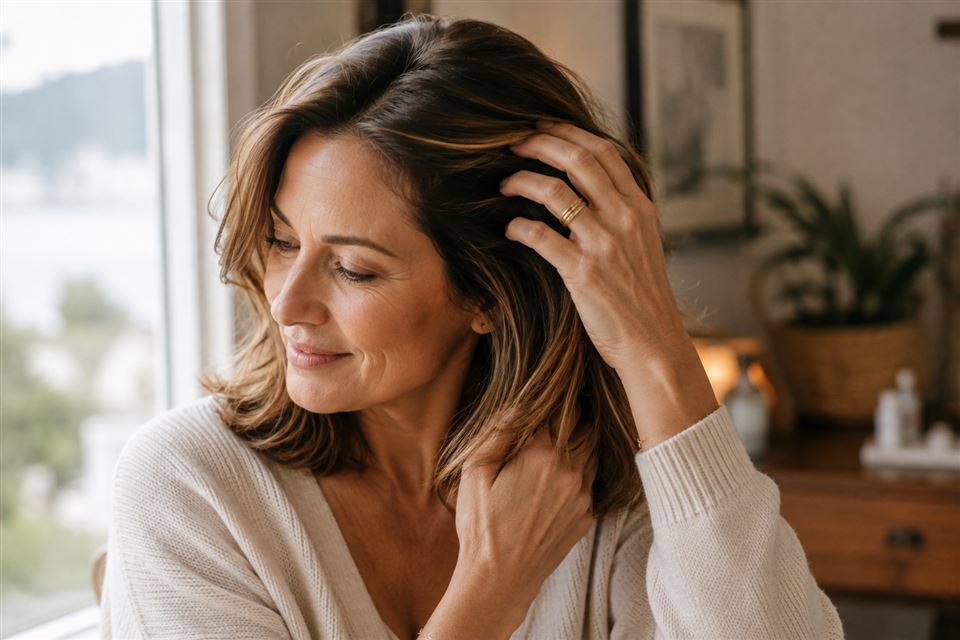
Is this the same as male pattern baldness?
Related but distinct in an important way. Male pattern baldness typically shows up as a receding hairline and crown balding in a well-defined pattern. Female pattern hair loss is usually diffuse — an overall reduction in density and a widening part — rather than isolated patches or a receding hairline, and it's driven by a similar but not identical hormonal mechanism.
Could it be something else — thyroid, iron deficiency, stress?
Genuinely worth ruling out before assuming it's purely hormonal aging. Thyroid dysfunction, iron deficiency (even without full-blown anemia), and significant physical or emotional stress can all trigger hair shedding — sometimes on their own, sometimes layered on top of the hormonal changes already happening. A simple blood panel can check thyroid function and iron levels, and it's a reasonable first step before starting any treatment, since fixing an underlying deficiency often resolves the shedding on its own.
Chronic stress deserves particular attention here, since elevated cortisol is a documented contributor to hair shedding — another thread connecting back to our cortisol guide and the sleep-stress cycle covered in why you wake up at 3 a.m. after 40.
What actually helps — evidence-based approaches?
Minoxidil (topical) has the strongest evidence of any over-the-counter option. It's approved specifically for female pattern hair loss and works by extending the growth phase of the hair cycle — results take patience, typically 4–6 months of consistent use before improvement is visible.
Address any underlying deficiency first. If bloodwork reveals low iron or thyroid dysfunction, treating that directly often improves shedding more than any hair-specific product would.
Be gentle with styling and heat. Tight hairstyles, aggressive brushing, and high heat all add mechanical stress to hair that's already more fragile — small changes here reduce breakage that compounds visible thinning.
Manage stress and sleep. Given cortisol's role, the same fundamentals that help everything else in this decade — consistent sleep, regular movement, stress management — genuinely apply here too.
What about minoxidil and other treatments?
Beyond over-the-counter minoxidil, a dermatologist can discuss prescription options, including anti-androgen medications in some cases, low-level laser therapy (with modest but real supporting evidence), and platelet-rich plasma (PRP) treatments, which show promising but still-developing evidence. There's no single best option for everyone — the right choice depends on the underlying cause and how advanced the thinning is, which is exactly why a real evaluation is worth more than guessing from a product aisle.
When should you see a dermatologist?
Bring it up if thinning is sudden rather than gradual, if you notice actual bald patches rather than diffuse thinning, if it's accompanied by other symptoms like fatigue or unexplained weight changes (possible thyroid signs), or if over-the-counter options haven't helped after several months of consistent use. A dermatologist can also rule out less common causes and offer treatments not available without a prescription.
Frequently asked questions
Is hair thinning after 40 normal, or should I be worried?
Gradual thinning is common and expected as estrogen declines. Sudden or patchy hair loss, rather than slow diffuse thinning, is what's worth a doctor's attention.
Does hair thinning from menopause grow back?
It depends on the cause. Female pattern hair loss tends to be gradual and progressive if untreated, but treatments like minoxidil can slow or partially reverse it, especially started early. Hair lost to a temporary trigger often regrows once that cause resolves.
Do biotin supplements actually help?
Only if you're actually deficient, which is uncommon with a typical diet. For most women, additional biotin has little evidence of benefit. A doctor can check for genuine deficiencies like iron or vitamin D instead.
What's the difference between shedding and actual thinning?
Shedding is losing strands (some daily loss is normal). Thinning is reduced density over time as follicles produce finer hair. You can have one without the other.
Sources
- American Academy of Dermatology — female pattern hair loss. aad.org
- National Institute on Aging — hair changes with age. nia.nih.gov
- The Menopause Society — hormonal hair changes during menopause. menopause.org

Chris S. — Founder & Writer
Chris is 46 and living the same chapter she writes about. She started The Well Chapter to turn solid sources into calm, practical guidance for women navigating the changes that come after 40 — without hype, fear, or miracle promises.