
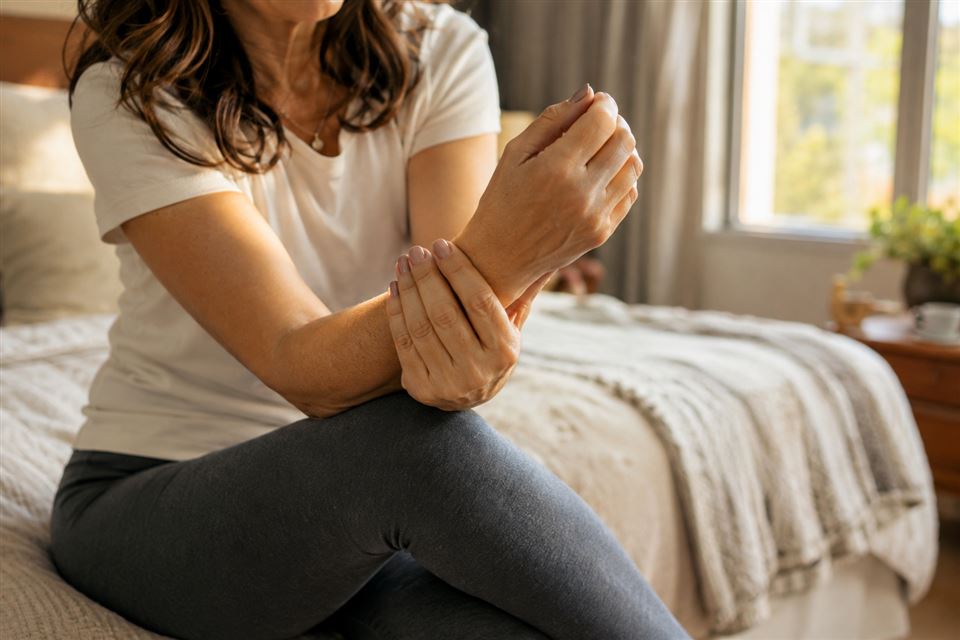
New stiffness in your knees, hips, or hands after 40 usually comes from a combination of factors — cartilage naturally thinning with use, declining estrogen's effect on joint tissue, and muscle loss reducing the support around joints. It's common, but it's not simply something to accept. Strength training, staying consistently active, and managing weight and inflammation all have real evidence behind them for keeping joints comfortable and mobile.
The stairs feel different than they used to. Getting up from the floor takes a small negotiation with your knees. A jar lid puts up more of a fight than it should.
None of this means you're falling apart — but it does mean something real is changing, and it's worth understanding rather than just working around quietly.
Why does joint pain become more common after 40?
Cartilage, the cushioning tissue at the ends of bones, naturally thins with age and decades of use — it has limited ability to regenerate itself. At the same time, the fluid that lubricates joints can become less abundant, and the muscles surrounding joints, which help absorb impact and stabilize movement, tend to shrink somewhat without deliberate strength work (the same process covered in our muscle loss guide).
Does estrogen decline really affect your joints?
More than most people realize. Estrogen receptors exist throughout joint cartilage and connective tissue, and estrogen appears to have a genuine anti-inflammatory, protective effect there. This is a real, if under-discussed, reason so many women notice new joint stiffness specifically arriving during perimenopause — not purely a coincidence of aging timeline, but a distinct hormonal contribution layered on top of it.
What makes joint pain worse — and what actually helps?
Inactivity worsens stiffness more than movement does. This runs counter to instinct, but joints genuinely respond to regular, moderate use — staying still tends to make stiffness worse, not better, for most everyday joint discomfort.
Extra weight adds real mechanical load. Every pound of body weight translates to several pounds of added force on weight-bearing joints like knees during movement — meaning modest weight changes can meaningfully change how joints feel day to day.
Strength training protects joints, not just muscles. Building the muscle around a joint gives it more support and shock absorption — our beginner's strength guide is a solid, low-impact starting point.
Low-impact cardio keeps joints lubricated without pounding them. Walking, swimming, and cycling are all gentler alternatives to high-impact options while still providing real cardiovascular and joint benefits — see our walking plan for a realistic starting point.
Anti-inflammatory eating patterns have modest, real evidence behind them. Diets rich in omega-3s, vegetables, and whole foods (and lower in ultra-processed foods) are associated with somewhat lower inflammatory markers, which may translate to less joint discomfort over time for some people.
Is this different from arthritis?
Everyday age-related joint stiffness and osteoarthritis exist on a spectrum rather than being entirely separate things — osteoarthritis is essentially more advanced cartilage breakdown, often in specific joints, and tends to involve more persistent pain, swelling, or reduced range of motion rather than general morning stiffness that eases with movement. The distinction matters because osteoarthritis benefits from a more targeted treatment conversation with a doctor, rather than general lifestyle measures alone.
When should you see a doctor about joint pain?
Bring it up if pain is persistent rather than occasional, if a joint is visibly swollen, red, or warm, if pain significantly limits your daily activities, or if over-the-counter measures and gentle movement haven't helped after a few weeks. These can indicate osteoarthritis, an autoimmune condition, or another cause that benefits from targeted treatment rather than general strategies alone.
Frequently asked questions
Is joint pain after 40 just normal aging?
Some increase in sensitivity is common as cartilage naturally thins, but hormonal changes, muscle loss, and inflammation all play modifiable roles too — it's not purely something to endure.
Does estrogen decline really affect joints?
Yes — estrogen receptors exist in joint cartilage and have a protective, anti-inflammatory effect there. Many women notice new stiffness specifically during perimenopause for this reason.
Should you exercise through joint pain or rest instead?
For everyday stiffness and mild pain, gentle movement generally helps more than rest. Sharp or acute pain from a specific injury deserves evaluation first.
Do supplements like glucosamine actually help?
Evidence is mixed and modest at best. Reasonable to try, but shouldn't replace strength training, weight management, and anti-inflammatory eating, which have stronger evidence.
Sources
- Arthritis Foundation — joint health and menopause. arthritis.org
- National Institute of Arthritis and Musculoskeletal and Skin Diseases (NIAMS) — osteoarthritis. niams.nih.gov
- The Menopause Society — joint pain and hormonal changes. menopause.org

Chris S. — Founder & Writer
Chris is 46 and living the same chapter she writes about. She started The Well Chapter to turn solid sources into calm, practical guidance for women navigating the changes that come after 40 — without hype, fear, or miracle promises.